Dear %%First Name%%,
We hope you've been enjoying your Monday Morning Motivator. If you've received this issue for the first time - welcome aboard! It only takes a couple of minutes to start your week off right with the MMM! Be encouraged by the success or great ideas of others in your business community. The MMM has a community of 94,402 subscribers.
Note : Please add Adam Advertising Group (drago@adamadgroup.com) to your address book to ensure it is not zapped by your spam filter.
Click Here to check out our recently updated YouTube Channel:
Click Here to check out our latest BLOG Post - Friends, Family, Staff & Customers - Are They Holding You Back?
Transformational Vocabulary
Words are a very big part of our business, finding the right words in TV, radio and video is extremely important for the clients we represent. Today we share a simple and profound message from Tony Robbins about the power of words and how they can transform our lives.
"Language shapes our behavior and each word we use is imbued with multitudes of personal meaning. The right words spoken in the right way can bring us love, money and respect, while the wrong words—or even the right words spoken in the wrong way—can lead to a country to war. We must carefully orchestrate our speech if we want to achieve our goals and bring our dreams to fruition." —Dr. Andrew Newberg, Words Can Change Your Brain
Check Out our latest video for West Coast Toyota - 2013 Highlander Review
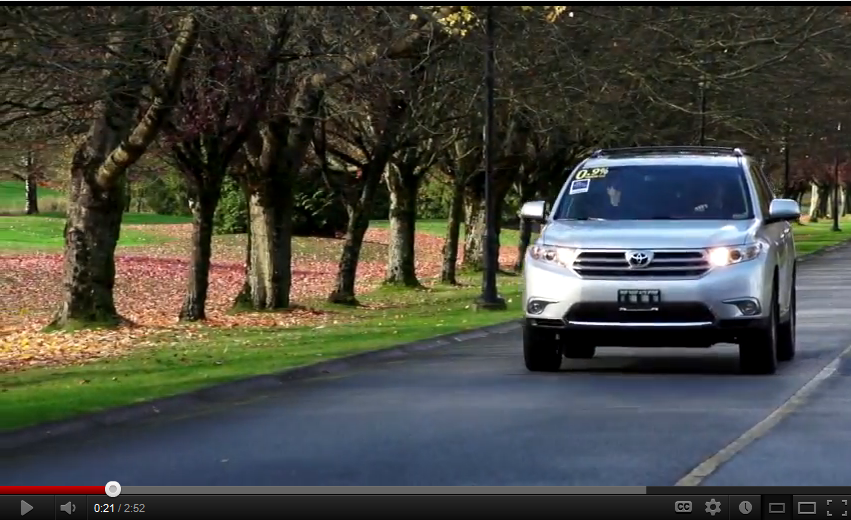
We tailor video production services for all businesses. Whether you are in retail, B2B or a public company our team will design a content creation solution that meets your needs. Drop us a line to find out more!
For the past 35 years I’ve had the privilege of working with more than 50 million people and I’ve observed firsthand the power of changing just one key word in communicating with someone and noted how it instantly changes the way people feel—and how they behave. And I can tell you that simply by changing your habitual vocabulary—the words you consistently use to describe emotions—you can instantaneously change how you think, how you feel, and how you live. This is the power of what I call Transformational Vocabulary—consciously using your words to improve the quality of your life today and for the rest of your life.
According to Compton’s Encyclopedia, the English language contains some 500,000 words. Yet the average person’s working vocabulary consists of 2,000—0.5% of the entire language. And the number of words we use most frequently—the words that make up our habitual vocabulary? For most people, it averages 200-300 words. Isn’t that unbelievable? (By contrast, John Milton’s writings used about 17,000 words and William Shakespeare used 24,000 words, 5,000 of which he only used one time.) Of those 500,000 words total, as much as 3,000 are used to describe emotions—2/3 of which are used to describe negative emotions.
With such amazing resources with which to express our feelings and ideas, why should people accept such an impoverished vocabulary? Most people are not challenged by the size of the vocabulary they understand, but rather by the words they chose to use. Our brains are working at high speeds; they’re trying to help us to process what things mean and what we should do as fast as we can. As a result, we tend to use the same words over and over again. Many times we use short cuts, but these short cuts often shortchange us emotionally.
For more than two decades, I’ve been testing with live audiences all around the world, asking them to take on a very simple task: Make a list of the emotions you feel at least once a week. I have people take five to ten minutes, and write down not all the emotions they feel in a rare while (i.e. once a month or year), but simply the ones they consistently feel. Ironically, whether the audience is 2,000 people or 30,000 people, 90% of the people write down an average of a dozen words—and more than half of those represent negative feelings. That means literally, out of the 3,000 words we have for emotions, most people feel about five or six good feelings; and the bad feelings we find over and over again. We tend to get happy and excited, then angry, frustrated, sad, or even depressed, as an example. Have you ever taken the time to actually become aware of the habitual words you use to describe the emotions that you feel? Do you think it’s possible that when we feel negative sensations, that those sensations are transformed emotionally by the word labels we put upon them?
The problem is that most often we do not choose our words consciously to describe our emotions. Any emotions we experience that are distressing, we have habitual words that we unconsciously attach to them, and the challenge of course is the words we attach to our experience become our experience. Words have a biochemical effect on the body. The minute you use a word like “devastated” you’re going to produce a very different biochemical effect than if you say, “I’m a bit disappointed.”
It’s not hard to see the impact of this when other people speak to us. For example, if someone said to you, “I think you’re mistaken,” versus, “I think you’re wrong,” versus, “You’re lying,” would you have a different biochemical response to that simple word? The same exact process happens with the words that we use within ourselves, but unfortunately, we’re less conscious of its impact.
I first became consciously aware of the power of the words we use to label the experience of our emotions during an intense negotiation, more than a decade and a half ago. I shared information to the other side that I thought would help my two business partners and myself to cut through the positioning and show good faith. Unfortunately, rather than reciprocating with good faith, the other side ended up using that information to try to leverage us in an unjust way to close the deal that would not be to our advantage.
To say it was upsetting at the time would be an understatement. As I left the meeting to sit down with my two other partners, I couldn’t help but notice that the three of us labeled the experience radically different. I was frustrated and angry, but in the midst of my own emotion, I was literally jarred by the intensity of one of my partners. He was enraged and talked about how furious he was by their response; and how he felt that they were “putting a gun to our head.” His face was beet red and he was totally out of control. I was trying to calm him down—the intensity of his emotion struck me because it seemed over the top to my anger and frustration. By contrast, I couldn’t help but notice that my other partner seemed completely unmoved by the experience. When I asked him, “You don’t seem to be upset by this. Aren’t you angry?” He said, “Well, no, not really. I’m a little annoyed by this.” I was incredulous, “Annoyed?” I asked, “Don’t you realize what these people have done?” He said, “Of course I do. It certainly peeves me a bit.” “Peeved?” I echoed back the word. “What do you mean, peeved?” To which he responded, “Well, it’s really just not worth being upset over and that’s how I feel.”
I was struck by how each of us used words that had such radically different levels of intensity—enraged versus angry versus and annoyed/peeved—and also how the experience of the event was radically different. How could it be that I was “angry” and “upset,” one of my partners was “furious” and “enraged,” and my other partner was “annoyed” and “a little peeved?” The word “peeved” itself “annoyed” me. I thought, “What a ridiculous word to describe what these people had done to us.” It seemed stupid in my mind. I thought to myself, I would never use this word to describe how I was feeling…but then again, I had never been that calm in an unjust situation. I began to wonder, “If I did, how would I feel?” Just to use the word “peeved” would probably make me laugh. It seemed so ridiculous.
Is it possible that the words we attach to our experience, actually become our experience? Do words have a biochemical effect? Over the next few weeks, I began to notice the pattern of language that different people had and how their language patterns produced a magnification of their emotion or a softening of it.
So I decided to try a 10-day challenge with myself where I would first identify the emotions that I experienced most often that were most distressing, and find a new word—a word that would soften or actually seem ridiculous to break my own pattern of thought and feeling.
I got my first opportunity after a long series of connecting flights, all of which were late. I arrived at my hotel at two in the morning, knowing I had to be up to speak at 8 a.m. and waited at the front desk for 10 minutes while the clerk searched for my name in the computer at a pace that would make a snail impatient. I felt the frustration gathering inside me, it started to build into anger, and I finally turned to the man, as I felt my intensity grow, and said, “I know this isn’t your fault, but right now I’m exhausted and I really need to get any room you can find for me because I’m starting to feel myself getting “a little bit peeved.” Just saying the word “peeved” by itself changed the tone of my voice and made the whole situation seem silly. The clerk looked at me perplexedly and then broke into a smile. I smiled back; my pattern was broken. As ridiculous and overly simplistic as this sounds, the simple replacement of the word I used within my own vocabulary, broke my pattern. It was like the difference between saying you’re “mistaken” versus you’re “wrong.” The emotional volcano that had been building up inside of me instantly cooled.
Could it really be this easy? Just by changing the habitual words we use to describe the emotions within ourselves, could we change the pattern of how we felt and therefore the quality of our lives? Ten days turned into a month and I can tell you, beyond a shadow of a doubt, it was a life-transforming experience. This is not to say there aren’t times when you want to feel angry or enraged, but wouldn’t it be nice to have that be a conscious choice versus just a habitual reaction?
Here’s what I found: If you want to change your life, if you want to shape your decisions and your actions, shifting your emotional patterns are the key. One fundamental tool that can change it faster than anything else is consciously selecting the words you’re going to use to describe how you feel. This is how you create a level of choice instead of a habitual reaction.
I call this Transformational Vocabulary because it gives you the power to change your experiences in life by taking the most negative feelings in your life and lowering their intensity to the point where they no longer control you. It also can be used to take positive experiences and increase them to even greater heights of pleasure.
Intellectually this sounds just like semantics, doesn’t it? What difference does it make to play with words? But if you test it in your own life experience, you’ll know it’s true. What would your life be like if you could take all your negative emotions and lower their intensity consistently? How much greater would the quality of your life be if you could intensify every positive experience you’ve ever had?
Throughout human history, great leaders have used the power of words to transform our emotions, to enlist us in their causes, and to shape the course of destiny. From Winston Churchill’s focus on the “finest hour” to Martin Luther King, Jr.’s depiction of a “dream” we are well aware that beliefs are formed by words—and they can be changed by words. But what about the ability we each have within us to use words to ignite change, to move ourselves to action, and to improve the quality of our lives?
We all know words provide us with a vehicle for expressing and sharing our experience with others. But do you realize that the words you habitually choose also affects how you communicate with yourself and therefore what you experience?
Is your business in need of transformation? Give us a call. We're here to help!
Have a great week unless you choose otherwise.
Drago
(Follow us on twitter now @AdamAdGroup)
PS -  For our friends in the car industry, we think you will enjoy our latest message - Google Reviews - Do's and Don'ts for Car Dealers For our friends in the car industry, we think you will enjoy our latest message - Google Reviews - Do's and Don'ts for Car Dealers
Here is our latest video for Zender Ford - Why Buy From Us
May of you know that my 13 year old son Caleb has Type 1 Juvenile Diabetes. We are proud of our new program Mybrandit. If you need gifts for your staff or clients, let our MyBrandit program help you. You will also be helping us as a portion of all sales from our MyBrandit program go to support The Juvenile Diabetes Research Foundation! Please click on the banner below to look around.

Testimonial Of The Week - Drago and his team truly desire the best for their clients and they work hard and “smart” to help them achieve their goals. Drago makes promises and keeps them. His core value of partnership has led to many opportunities of mutual benefit for all involved. If you have anything to tell the world, online, traditional or in ways you may not even have thought of, then it’s well worth your while to call them for advice and assistance. You’ll be glad you did!
(Timothy Driedger - General & Brand Manager, Jim Pattison Toyota & Hyundai)
We also wanted to say Thank You for allowing us to meet with you every Monday Morning. The MMM has experienced incredible growth with a subscriber base of 94,402 people.
To Sign Up For The MMM simply send an email to drago@adamadgroup.com with the word subscribe in the subject line.
We are truly grateful and humbled by the positive comments we receive weekly. If you enjoy the MMM please pass it along and let others know about it.
To see our newsletter archives Click Here! or copy and paste the following link into your browser http://adamadgroup.com/newsletter-archive/
Please meet some of our fabulous clients or view their commercials at our YouTube Channel:
British Columbia Law Institute - www.bcli.org
Sherwood Park Dodge - www.sherwoodparkdodge.com
Zender Ford - www.ZenderFord.com
West Coast Toyota - www.westcoasttoyota.com
West Coast Ford - www.westcoastfordlincoln.com
4D LABS - www.4Dlabs.ca
Dominion Lending - www.dominionlending.ca
Ask Scott - www.AskScott.ca
South Centre VW - www.southcentrevw.com
South Centre Fine Cars - www.southcentrefinecars.com
West Coast Mazda - www.westcoastmazda.com
Kia West - www.kiawest.com
BC Hyundai Dealers - www.HyundaiCanada.com
North Shore Acura - www.NorthShoreAcura.com
Ken Evans Ford - www.kenevansford.com
Cold-FX - www.Coldfx.com
Jim Pattison Toyota - www.jptoyota-surrey.com
Spraggs & Company - www.AskTom.ca
Jim Pattison Hyundai - www.jpautogroup.com
Capital Direct - www.CapitalDirect.ca
Jim Pattison Lexus - www.jimpattisonlexus.com
Happy Honda - www.HappyHonda.com
Watkin Motors - www.WatkinMotors.com
Buist Motors - www.Buistmotors.com
The King Of Floors - www.KingOfFloors.com
Bon Voyage Travel - www.BonVoyageTravel.com
Cove Mortgage - www.CoveMortgage.com
Mattress Mattress - www.MattressMattress.com
Israel Tours - www.Israeltoursforchristians.com
Briar Design & Construction - www.Briarrenos.com
Spa Utopia - www.SpaUtopia.ca
Direct Buy - www.Directbuy.com
Crystal Clear Water - www.crystalclearh2o.ca
Cummins - www.Cummins.com
The Hockey Shop - www.TheHockeyShop.com
Prestigious Properties - www.PrestProp.com
Ralph's Auto Supply - www.Ralphsauto.com
Royal City Jewelers & Loans - www.Rcj.ca
Sunshine Coast Health Centre - www.Sunshinecoasthealthcentre.ca
Sears Carpet & Upholstery Care - www.Searscarpetcleaning.ca
SureSlim - www.SureSlim.ca
Surrey Golf Club - www.SurreyGolf.com
Tell Del - www.TellDel.com
Tourism Surrey - www.TourismSurrey.com
Just to name a few…
Success Profile
This week's success profile is The West Coast Auto Group.
The West Coast Auto Group is steeped in rich history as West Coast Motors was first incorporated in May of 1953.
Today the West Coast Auto Group has 5 Brands under its umbrella, Ford/Lincoln, Mazda, Toyota, Nissan and Kia. Being so rich in history, it's easy to see why their business has been built on referral and repeat customers and their dealerships are consistently rated among the top dealerships in Western Canada for customer satisfaction and retention.
Employing over 200 people makes them one of the largest employers in Pitt Meadows and Maple Ridge. They are deeply committed to their staff and community, supporting and funding many charities and sports programs.
Their working relationship between all five brands ensures a greater exchange of ideas and knowledge which translates into a better car buying experience for the customer!
So if you are in the market for a Ford/Lincoln, Mazda, Toyota, Nissan and Kia, give them a call and discover what all their customers have come to know, that they won't be out srviced or undersold!
To find out more visit www.WestCoastAutogroup.com
Can The Adam Advertising Group help your business, or do you have a success story we should hear about?
Contact Drago Adam at drago@AdamAdGroup.com
or call 604 937 - 8886 or 866 923 - 6477
Click Here! for our newsletter archive. |